


美국회, `주한미군 완전철수'도 검토, 충격


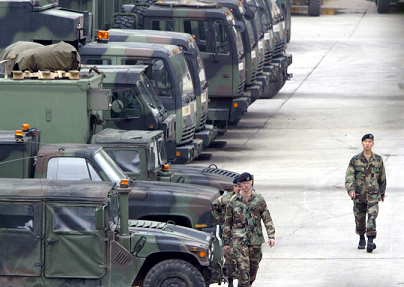 미국이 한반도에서 모든 미군을 완전히 철수시키는 방안을 최근 국회 차원에서 검토한 사실이 확인되어 충격을 주고 있다.
미국 하원 예산국은 주한미군을 포함한 해외미군을 본국으로 철수시키거나 감축 또는 재배치했을 때 발생하는 비용과 효과를 분석한 보고서를 최근 발표했다고 미군전문지 성조지 인터넷판이 20일 보도했다.(아래 원문보기)
이 보고서는 도널드 럼즈펠드 미국방장관이 그동안 핵심적으로 구상해온 한국과 독일 미군의 변화 가능성에 초점이 맞춰져 있어 향후 미정부의 해외미군 주둔지 재결정에 어떻게 영향을 미칠지 주목된다.
럼즈펠드 장관은 올 2월 "해외주둔 미군 재배치에 따른 가장 큰 변화는 독일과 한국 등에서 일어날 것"이라고 밝혔다.
이번 보고서는 `럼즈펠드 구상'에 따라 한국, 일본, 하와이 기지들이 통.폐합되는 가운데 태평양 지역의 안보의 주축으로 부상할 것이 확실시되는 일본주둔 미군의 재배치 문제는 전혀 언급하지 않았다.
보고서에 따르면 한국과 독일에서 거의 모든 미군을 철수시킬 경우 부대 이전에 따른 선행비용이 68억∼74억달러가 소요될 것으로 추산되나 연간 운영비용은 종전에 비해 12억달러까지 절감할 수 있다.
그러나 한반도에 돌발상황이 발생했을 경우 미군 배치시간이 늘어나 전쟁발발 가능성이 늘어날 수 있는 게 부담이라고 보고서는 지적했다.
보고서는 또 거의 모든 주한미군을 미국 본토로 철수시킨 뒤 3개 전투여단을 유럽과 한국으로 순환배치시킨다면 초기 운용비용은 68억∼74억달러가 소요되나 연간 9억2천500만달러의 예산절감 효과를 거둘 수 있다고 분석했다.
이 방안이 안보환경에 미치는 영향을 보면 군병력 9천∼1만5천명을 줄이는 이점은 있으나 한반도 유사시 병력동원 시간이 늘어나는 단점이 있다고 보고서는 평가했다.
한미 양국이 지난해 4월부터 추진해온 미래동맹 회의를 통해 합의한대로 용산기지와 미2사단을 한강이남으로 재배치한다면 카스피해 인근 옛소련 지역이나 중동으로 미군을 동원하는 속도는 늘릴 수 있으나 매년 2천500만달러의 예산이 증가된다고 보고서는 내다봤다.(konas)
Study weighs costs, benefits of options in shifting U.S. overseas forces
By Steve Liewer, Stars and Stripes
European edition, Wednesday, May 19, 2004
A new study by the Congressional Budget Office warns that a large shift in U.S. forces overseas to Eastern Europe, Africa or the States would cost a lot of money up front and might offer little or no benefit down the road.
The report, requested last winter by the Senate Budget Committee, predicts the costs and benefits of a range of options, from simply eliminating accompanied tours overseas to moving almost all soldiers based in Europe and South Korea home to the United States.
The study weighed the reduced costs of keeping up schools, houses and recreational facilities overseas against the added costs of building bases, barracks and houses for them in other places.
It also analyzed how much faster troops could deploy to likely trouble spots, the number of troops ready to deploy, and the impact on family separation. Among the study’s conclusions: ¶ Moving forces to new locations in Eastern Europe may only slightly improve their ability to respond faster to trouble spots.
While rotating stateside-based forces to forward bases would cut overseas infrastructure costs, it would also reduce the number of troops available for operations and increase the time troops spend away from their families.
Any major shift of forces will require “significant spending.”
New overseas locations will not reduce the cost of maintaining troops. While it makes sense that a report requested by the Senate Budget Committee would focus on pocketbook issues, the Bush administration’s reason for considering changes to the global force posture “was never about the money,” a Pentagon official familiar with global posture said Tuesday.
Instead, “the Secretary [of Defense, Donald Rumsfeld] has said from the beginning that we’ll move people where we need them” for strategic reasons, not as a money saving measure, the official said.
With the 2005 defense budget authorization bill on the Senate floor for vote, spokesmen for relevant congressional committees were unavailable for comment Tuesday. It’s not clear yet what impact the Budget Office report will have on decisions about overseas bases.
However, while the plan to shift forces first seemed on a fast track to approval, it appears to be slowing down. After a meeting with U.S. European Command commander Marine Gen. James L. Jones last week, the governor of the German state of Baden-Württemburg, Erwin Teufel, issued a statement saying he doubted any decisions about base closures would be announced before 2005. That echoed a comment by Sgt. Maj. of the Army Kenneth Preston two weeks ago to 1st Infantry Division soldiers and families in Würzburg.
Preston said he expected no announcements until late next year, after Congress decides on its next round of stateside base closures.
This is noted in the report, which reads in part: “Transferring tens of thousands of Army troops back to the United States could complicate preparations for the round of base realignments and closures being planned for 2005. Because of BRAC rounds carried out in the 1980s and 1990s, the Army has little or no excess capacity at bases in CONUS.
“Thus, increasing the population of Army personnel in CONUS — as these options would do by as much as 23 percent — would require building new facilities in this country. If closing existing bases is considered during the upcoming BRAC round, the need to house forces in the United States that are now stationed overseas could preclude some of those closures.
” Robert Work, a senior defense analyst with the Washington-based Center for Strategic and Budgetary Analysis, said other matters have pushed overseas base closures off the Pentagon’s front burner.
“The discussions on the basing continue to go on,” he said. “But my sense is, with everything going on in Iraq and with the election in six months, I don’t expect we’ll see anything soon.
” The realignment of overseas troops — especially those in the Army — has been a centerpiece of the Bush administration’s “transformation” plans for the U.S. military. Basing change sought Rumsfeld has argued that the current basing structure, rooted in Cold War politics, is badly in need of an update. Rumsfeld instead has called for a smaller, more mobile force that is based closer to the likely sites of future conflicts — places such as Africa, the Middle East or the oil-rich Caspian Sea region of the former Soviet Union.
Many of the older bases, such as Yongsan Garrison in Seoul, stand in areas that once were isolated but now are surrounded by cities, causing battles with local people over pollution and noise. Last year, Rumsfeld negotiated a deal with the South Korean government to pull Army forces out of Seoul and into new bases farther from the North Korean border.
Jones outlined an ambitious plan to reduce the Army’s presence in Germany while boosting it in Eastern Europe and Africa, and returning thousands of troops to stateside bases. The Pentagon expected to announce specific base closures by fall, and rumors spread of shutdowns in Germany as early as this year.
Since then, the process has slowed down. Instead of announcing base closures last winter, Undersecretary of Defense Douglas Feith announced a period of consultation with other branches of government and with allies. Lt. Cmdr. Rick Haupt, a EUCOM spokesman, said the command just learned of the CBO study Tuesday and doesn’t yet have any comment on the findings. “A fundamental decision has not been made yet,” he said.

- 관련기사보기
-





- 입력 된 100자 의견이 없습니다.
